
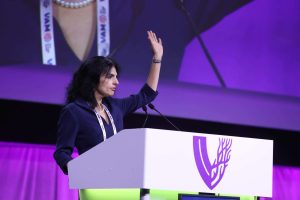
One in five endovascular procedures fails within six months and for decades vascular surgeons have answered that statistic with the same blunt toolkit: aspirin, clopidogrel, or whatever combination a given surgeon prefers. This year’s Frank J. Veith Distinguished Lecture at VAM 2026 argued that guesswork is no longer good enough and that a simple blood test may finally tell clinicians which patients are headed for failure before it happens.
This year’s lecture was given by Anahita Dua, MD, associate professor at Harvard Medical School and vascular surgeon at Massachusetts General Hospital, who argued for a more individualized approach to post-revascularization anticoagulation.
Dua opened the lecture by describing the disconnect at the center of modern vascular practice: enormous technical investment during the procedure itself, followed by a return to decades-old, one-size-fits-all blood thinner regimens once the patient leaves the operating room.
“We spend all of our time, all of our money and resources,” said Dua. “But the second you’re done with that six-hour procedure where you now have flow, you go to the PACU where you go right back to medieval times.”
That gap, Dua explained, stems from a poor understanding of hypercoagulability in the months following revascularization, compounded by clinical trial data that fails to reflect real-world patients. Up to 25% of patients are resistant to clopidogrel and another 10% are resistant to aspirin, meaning uniform prescribing leaves a substantial share of patients undertreated without anyone realizing it.
“At this point, a one-size-fits-all approach is not working,” said Dua. “We’re spending so much time and money revascularizing these patients and not knowing what to do next.”
Dua’s lab turned to thromboelastography with platelet mapping, a test traditionally used in trauma and cardiac surgery to guide blood transfusion and applied it instead to predict clotting risk in PAD patients. Testing patients at intervals after revascularization, her team found that results collected 30 days before a thrombotic event reliably predicted it, giving clinicians a window to intervene before failure occurred. Platelet aggregation emerged as the strongest predictor and further analysis identified a specific target: roughly 30% platelet inhibition, low enough to prevent clotting without raising bleeding risk.
“We called it the Goldilocks solution because it’s just right,” said Dua. “Not too hot, not too cold.”
Their research also revealed a significant sex-based difference in treatment response. Despite comparable medication adherence, postmenopausal women in the study were consistently more likely to thrombose, undergo amputation and experience delayed wound healing than men were. Platelet testing showed that women’s platelets simply did not respond to aspirin and clopidogrel the way men’s did, even at identical doses.
“Women are not appropriately responding,” said Dua. “It’s not a genetic thing. It has to do with their particular platelets as females.”
Building on those findings, Dua’s team developed an algorithm using thromboelastography results to adjust blood thinner therapy in real time, then tested it in a single-arm interventional study. Compared with standard treatment, patients managed under the guided protocol showed significantly lower rates of thrombosis and stenosis, improved amputation-free survival, fewer amputations and better overall survival, with no major bleeding events recorded in the guided-therapy group.
“The intervention is not the blood thinner,” said Dua. “The intervention is the guidance.”
The team’s work has since expanded into a multicenter randomized controlled trial spanning four institutions, with roughly 500 patients enrolled to date and early results continuing to favor the guided approach. Dua described the effort as an attempt to move vascular surgery away from reflexive prescribing and toward therapy tailored to each patient’s underlying biology.