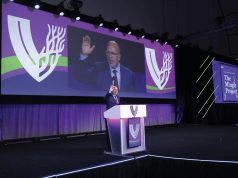
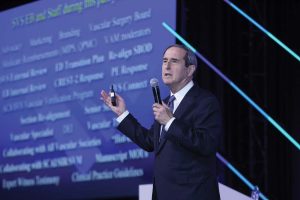
During his presidential address at VAM 2026, Keith Calligaro, MD, called on vascular surgeons to think beyond today’s clinical challenges and outlined a vision for the specialty built around unity, innovation, education and patient advocacy.
Speaking before a record-breaking attendance at the annual meeting, Calligaro framed his address around the theme of “family and future,” reflecting on the mentors, colleagues and trainees who shaped his career before turning his focus to what he described as 10 priorities for vascular surgery’s future.
“The biggest threat to our specialty is not cardiologists and it’s not low reimbursements,” said Calligaro. “It’s divisiveness among ourselves. By speaking and acting with one voice, we can accomplish anything.”
Among his priorities was strengthening the identity of vascular surgeons as the experts in vascular disease. While multiple specialties perform vascular procedures, Calligaro argued that vascular surgeons remain uniquely qualified to offer the full spectrum of medical therapy, endovascular intervention and open surgery.
“We are the only specialty to offer one-stop shopping,” he said. “No one else can do that and we need to make that known as best we can.”
Calligaro also called for broader adoption of appropriate use criteria across specialties, saying vascular surgeons, cardiologists and interventional radiologists should work toward shared standards that ensure patients receive interventions only when appropriate.
Innovation represented another major theme. He predicted advances in robotics, artificial intelligence and device technology will reshape vascular surgery, highlighting the newly established Enrico Ascher Vascular Innovation Institute as an important investment in the specialty’s future.
Training also must continue to evolve, he said, noting declining exposure to complex open aortic surgery and growing interest in focused practice areas such as venous disease. Rather than maintaining a one-size-fits-all model, Calligaro suggested future training pathways should provide greater flexibility while preserving comprehensive vascular expertise.
He also emphasized the need to expand independent vascular centers, secure fair physician reimbursement, support diversity while maintaining merit-based leadership and improve work-life balance to sustain the specialty’s workforce.
Calligaro proposed what he called a “Vascular Bill of Rights,” encompassing professional autonomy, fair reimbursement, innovation, modernized training and respectful collaboration.
He concluded by reminding attendees that the strength of the specialty ultimately depends on the people within it. “You are my family,” said Calligaro. “We are all family. By working together as family, I am very optimistic that vascular surgeons have a very bright future.”