This advertorial is sponsored by Siemens.
Two leaders in vascular surgery preview the future of interventional imaging and consider the emergence of the hybrid operating room (OR) as a future model for success.
The hybrid OR is emerging as a cornerstone development in the future of interventional imaging. With seamless integration of advanced imaging technologies with traditional surgical tools, hybrid ORs will deliver real-time, high-resolution visuals during new and complex interventional procedures. The expected result will be greater precision, faster decision making coupled with improved patient outcomes.
As minimally invasive techniques continue to evolve, hybrid ORs will enable multidisciplinary teams to collaborate in new ways to enhance the safety and efficiency of treatments.
The continued development and adoption of hybrid ORs will undoubtedly transform the landscape of modern medicine, pushing the boundaries of what can be achieved in surgical and interventional care.
The future of vascular surgery and the role a hybrid OR plays in the space took center stage at the 2024 edition of the VEITHsymposium in New York City (Nov. 19–23).
Daniel Clair, MD, chair of the Department of Vascular Surgery at Vanderbilt University Medical Center in Nashville, Tennessee, and Alan Lumsden, MD, the Walter W. Fondren III presidential distinguished chair, at DeBakey Heart & Vascular Center, Houston Methodist Hospital, in Houston, Texas, weighed in on how new advances and changing concepts in interventional imaging will transform tomorrow’s interventional imaging suite.
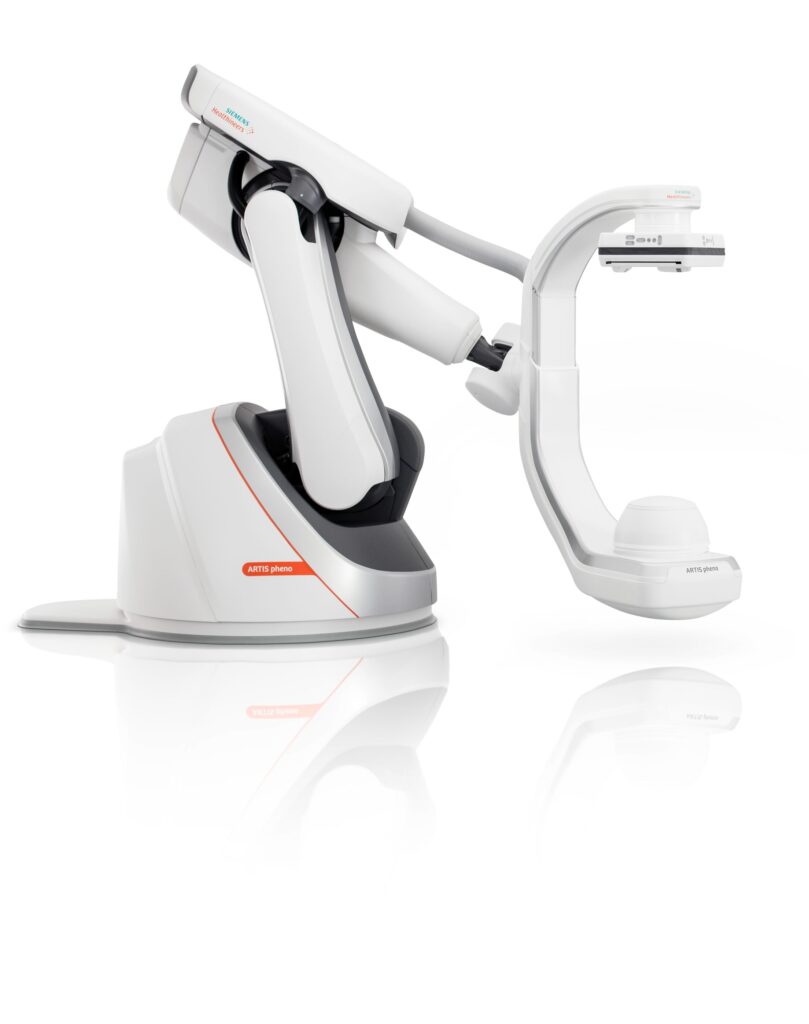
A hybrid OR is a surgical space that combines traditional operating equipment with imaging technology. This allows surgeons to perform both open and minimally invasive procedures in the same room, without moving the patient. Houston Methodist Hospital and Vanderbilt University Medical Center both leverage the features of ARTIS pheno from Siemens Healthineers.
The robotic C-arm will play an important role in future interventional imaging solutions, where high-quality imaging must be met with robust flexibility to satisfy the demand for mixed, multi-modality solutions.
What does the future of vascular surgery look like for you, and how does medical imaging play a role in that future?
DC: As I think about the future of vascular surgery, we’re already seeing indications of what’s to come with a move towards less invasive procedures, more outpatient procedures, and the combination of open and interventional procedures. Almost all of it involves imaging in one way or another.
I do think that as we move forward, mechanisms to reduce radiation dosing for physicians and for patients is going to be a critical aspect of imaging and its integration with imaging as well.

AL: We’re an imaging-dependent specialty. Again, let’s talk about what imaging is to us. It’s ultrasound, and obviously Siemens Healthineers is a big player in the ultrasound space.
Vascular surgery always plays a major role in vascular ultrasound, but it’s also about computed tomography (CT), magnetic resonance (MR) and intravascular ultrasound (IVUS) and all the other imaging modalities.
Our specialty uses what I call applied imaging. What we really try to do is figure out how to use the imaging modalities to better treat the patients.
In the past, you got a CT scan and then you diagnosed an aneurysm. It’s not like that anymore. Now, we take that CT scan, we diagnose the aneurysm, we fuse that on top of the patient, and we deploy complex devices based upon the CT scan.
So, the CT scans must be good. That really was one of the things that pushed us into getting involved in the preoperative CT scan.
The nice thing is that the CT scans are generic, but not completely. So, understanding how that CT scan is acquired and the timing of the contrast is important for us.
We’re fortunate at Methodist because the DeBakey Heart and Vascular Center owns the cardiovascular movement. It’s all done by clinicians. I think that’s a big advantage in helping me understand what I need to know to execute all of these complex procedures.
DC: The integration of imaging in fluoroscopy rooms, and in rooms with imaging that is based on them—combining different modalities of imaging and using them virtually in the OR—is increasingly going to be something we do.
It is something we will need to have the capacity to do. That’s certainly true for interventional procedures, and I actually think it’s true for open procedures as well. It’s kind of a mixed reality assessment of the patient.
AL: Here’s an example. When we want to do a case, we don’t access a blood vessel without using ultrasound—and that’s transformed our ability to utilize many different blood vessels to perform ever more complex interactions safely.
So, we use ultrasound to get access. We use a CT scan to fuse with our pheno image. And we use fluoroscopy to monitor the procedure. The hybrid OR is the forum by which we can mix these different imaging technologies.
We spend a long time planning endovascular procedures, and then we just go and do an open operation without having looked at the CT scan. All that information is still there.
Increasingly, I think we need to educate residents so that they know there is a retroaortic renal vein because it’s on the CT scan. If we go to type II endoleaks, we ought to know where the lumbar arteries are and how we’re going to localize them, because they are all right there on a high-quality CT scan.
Using cinematic rendering, we can make the CT scan look ever more like surgical anatomy. As we explore robotics, this can be valuable in planning open and robotic procedures.
You’re starting to use robotics and navigation with no radiation. Where do you see these two capabilities coming into play in the future?
DC: I do think that robotics are going to be a significant part of how we evolve [as a specialty]. There are portions of what we do in vascular surgery that are not going to convert over to interventional or endovascular therapies. There is no question that if you look at recovery times and impairment and morbidity from larger vascular procedures—or larger procedures of any kind—these variables are reduced with the use of robotics. That’s number one.
Number two, if you are just looking at non-fluoroscopy or virtual imaging as a method of doing interventions, there is no question that it provides better guidance with good imaging and reduces the time and radiation exposure for the patients, staff and physicians.
All of that will be a significant part of what we do in the future.
AL: We must parse this out into endovascular robotics and surgical robotics. I know endovascular robotics has had its challenges. [But]I still think it’s going to come back.
Look at the relationship you have with Intuitive or on the Ion [Robotic Bronchoscopy] platform. Most people here do not even know what the Ion is. And that’s an example of how, if it is not happening within your own specialty, you have no direct line of sight to it.
I think about the bronchi as long thin tubes, just like blood vessels. What Intuitive has done—and part of it is partnering with Siemens Healthineers—is you’ve got a preoperative CT scan, and you see a lung nodule. You bring your C-arm in and allow fusion to occur. You then diagram a path for the endobronchial robot, through those long thin tubes, to a peripheral target using fused imaging.
So, I think robotics can take you to one level. And then I think imaging can take you to another level. The power is going to be in putting these two things together, so now the imaging is space-specific and driving the robots. It is saying that either, “No, you cannot go in that area,” or, “This is the path that you are going to take to get there.”
If it can be done in the bronchi, I see no reason why it can’t be done in the blood vessel.
We’ve discussed a lot of technologies. How can they be used together in a hybrid OR?
AL: We need to have someone who translates the imaging capability and understands what the physician needs and helps make that bridge. That’s the physician at the moment, but there is a real need for imaging specialists who bridge the gap between what the imaging can provide and what we need. How you find those people is a challenge. That is the difference between creating a CT scan and creating an imaging modality that we can actively engage with.
DC: As clinicians there is a lot that we want in terms of imaging and its integration through multiple modalities. That interaction between engineers who design the systems and physicians who use them is what is going to drive the changes we need to see. That interaction will help us bridge the gap between what we need and what is actually possible.
All of us need to be involved. Without that interaction, it is difficult. That interaction allows us to be able to say, “I’d like this to do endobronchial, but what if we combined it with a thoracoscopic intervention done by a robot at the same time so that we can divide the blood vessels directed to that area?” This is the integration and the interaction that improve what we’re doing.
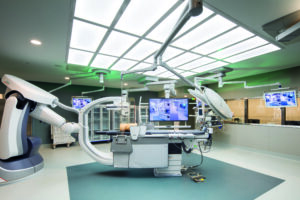
Hybrid ORs in interventional imaging integrate multiple imaging modalities to provide more accurate, real-time and comprehensive guidance during minimally invasive procedures. They are equipped with imaging systems and robotic equipment that combine the strengths of the different imaging technologies to improve diagnostic accuracy, procedural precision and patient outcomes.
Nationally ranked Houston Methodist DeBakey Heart & Vascular Center is home to four such operating rooms within its Texas Medical Center campus, bringing highly advanced care to patients in the Houston area. The rooms combine advanced medical imaging devices and an operating room. In short, these new hybrid ORs will allow for more minimally invasive procedures for both cardiovascular surgery and neurosurgery.
Cardiovascular surgeons, cardiologists, neurosurgeons and neurologists from these centers believe that the advanced technology in this building will transform clinical care for the future and will serve as the new standard for similar facilities around the country.
In 2022, Vanderbilt University Medical Center opened two of the latest generation of hybrid ORs, and each combine a traditional operating room with the latest advanced imaging equipment, simplifying procedures and allowing them to be more efficient and safer for patients.
Though Vanderbilt has built a handful of such rooms in recent years, these are the medical center’s first that will be shared by a multidisciplinary cohort. Teams performing cardiology and electrophysiology procedures as well as cardiac and vascular surgery will benefit from the sophisticated technology in the room—and from each other.
Both medical centers leverage the advanced robotic imaging capabilities of the ARTIS pheno from Siemens Healthineers. ARTIS pheno significantly improves precision and workflow during complex procedures. It delivers high-definition, 3D imaging with a level of detail that helps surgical teams visualize anatomical structures in real time, facilitating more accurate interventions.
The robotic design enables flexible and precise positioning, ensuring optimal imaging angles without the need for time-consuming manual adjustments. This efficiency not only accelerates the procedure but also reduces radiation exposure for both patients and medical staff.
With its ability to seamlessly integrate into the hybrid OR environment, ARTIS pheno supports a wide range of minimally invasive surgeries, ultimately enhancing the overall success of interventional procedures and improving patient outcomes.
The robotic imaging system was built to expand a hybrid OR’s ability to perform multiple surgical and interventional procedures. More than 1,350 hybrid operating rooms and interventional radiology suites worldwide are using the versatility of ARTIS pheno in order to advance their case mix and better facilitate more complex procedures.
To learn more about the role of the robotic ARTIS pheno in hybrid ORs, visit www.siemens-healthineers.com/en-us/clinical-specialties/surgery/surgery-product-portfolio/hybrid-or/artis-pheno.