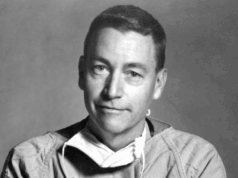
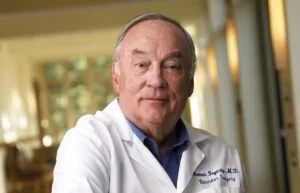
Thomas J. Fogarty, MD, a dedicated surgeon and trailblazing innovator who revolutionized medical technology when he created the first ever minimally invasive surgical device, died peacefully on Dec. 28, 2025. He was 91.
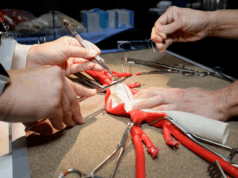
Born on Feb. 25, 1934, in Cincinnati, Ohio, Fogarty graduated from Xavier University and the University of Cincinnati College of Medicine, earning his medical degree in 1960. A lifelong tinkerer, Fogarty developed the balloon embolectomy catheter during his residency training at the University of Oregon. Fogarty would eventually go on to be granted over 190 medical patents, including for the Hancock tissue heart valve and the AneuRx endovascular aortic stent graft.
“Tom was a natural innovator with the unique ability to see things not as they were, but as they could be,” said Andrew Cleeland, CEO of Fogarty Innovation. “He didn’t just conceive novel solutions to important unmet needs — he had the grit and determination to bring those technologies all the way to the bedside.”
Fogarty began his career at Stanford University and served as the medical staff president at Stanford Medical Center from 1973-1975. He left academia and spent 13 years as director of cardiovascular surgery at Sequoia Hospital in Redwood City, California, before returning to Stanford in 1993. He was also credited with founding or co-founding over 45 companies, as well as establishing the educational nonprofit Fogarty Innovation in 2007.
In 1995, Fogarty was elected president of the Society for Vascular Surgery (SVS). During his tenure, he focused on key issues such as advancing the specialty’s voice in national health policy, strengthening training and research, and championing innovation rooted in bedside needs to improve patient care.
Among his many accolades, Fogarty was inducted into the National Inventors Hall of Fame in 2001, received the SVS Medal of Innovation in Vascular Surgery in 2010, and was awarded the Presidential National Medal of Technology and Innovation by Barack Obama in 2012.
“Tom’s impact was vast — far greater than most realize,” said Cleeland. “His guiding principle was always ‘patients first,’ and he served them directly as a physician and indirectly through his work as an innovator, educator, investor, and mentor. Through these endeavors, he helped build an entire community dedicated to finding ‘a better way’ — one grounded in early and continuous collaboration and in the belief that developing people is as important as developing products.”