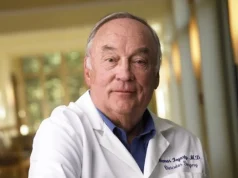
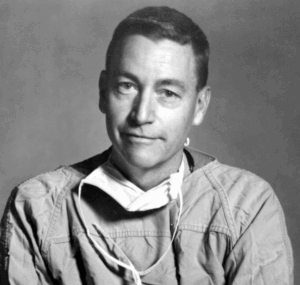
Clyde F. Barker, MD, a towering figure in American surgery and a transformative leader at Penn Medicine, died peacefully at his home on Oct. 2, surrounded by family. He was 91.
“So ended an era,” said Ronald DeMatteo, MD, chair of surgery at the University of Pennsylvania. “Surgeon, innovator, scientist, leader, administrator, counselor, husband, father, athlete, historian and friend. The term ‘giant’ is often applied to individuals who make important contributions to medicine or medical education. That label seems insufficient to describe Dr. Barker. Rather, he was a titan.”
Barker dedicated 67 years to Penn Surgery, beginning his general surgery training in 1958 and never leaving. He became a professor in 1973 and chief of vascular surgery in 1981. From 1983 to 2001, he served as the John Rhea Barton professor and chair of surgery, shaping generations of surgical leaders and researchers.
Born in Salt Lake City, Utah, Barker graduated from Phillips Exeter Academy and Cornell University, later earning his medical degree from Cornell Medical School in Manhattan, New York. A nationally ranked amateur tennis player, he brought the same discipline and boldness to the operating room.
He performed the first kidney transplant at the Hospital of the University of Pennsylvania and led Penn’s transplantation of clinical care and research. Collaborating with immunologist Rupert Billingham, Barker contributed seminal papers on immune tolerance. His work with Ali Naji, MD, yielded two Science publications that advanced understanding of autoimmunity in diabetes and tolerance induction in islet transplantation.
Barker’s research was continuously funded by the National Institutes of Health (NIH) for 25 years, including five R01 grants and an NIH Merit Award. He published more than 400 papers and served on editorial boards, including that of Annals of Surgery.
Beyond Penn, Barker held leadership roles in nearly every major surgical society, including presidencies of the American Surgical Association, American Society of Transplant Surgeons, Halsted Society, International Surgical Group, and the Philadelphia Academy of Surgeons. He also chaired the Board of the William Maul Measey Foundation and served as president of the American Philosophical Society.