Brought to you by:


Reclaiming joy and meaning in vascular practice
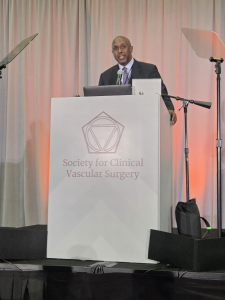
“When was the last time in surgery that you experienced joy,” asked Vincent Rowe, MD, during his presidential address at the 2026 Society for Clinical Vascular Surgery (SCVS) Annual Symposium in San Diego, California (March 28-April 1). “Not just satisfaction, not relief or just getting happy that things were over, but joy — real joy.”
Rather than focusing on outcomes or technical advances, Rowe’s address centered on a question rarely discussed in vascular surgery: how surgeons experience meaning in their work and how that sense of purpose can change over time.
Rowe, chief of vascular and endovascular surgery at UCLA, described moments of clarity and perfect alignment as foundational to the field, but increasingly difficult to recognize amid the demands of modern practice. Vascular surgeons, he noted, operate at the intersection of high complexity and consequence, treating some of the most medically fragile patients.
That reality creates a persistent weight surgeons carry, both technically and emotionally, but Rowe emphasized that the burden itself is not a sign of dysfunction. “The weight is not evidence that something is wrong,” he said. “It's evidence that the work we do matters.”
At the same time, Rowe acknowledged the broader healthcare environment has evolved significantly, adding layers of administrative complexity and performance pressures that can distance surgeons from the meaning of their work. “It's a cognitive weight that's just strangling us as a profession,” he said. “And it begins to distance us from those moments that give us joy.”
Despite these challenges, Rowe pointed to the field’s continued progress. Advances in technology and technique have expanded treatment options, allowing surgeons to care for increasingly complex patients without worsening outcomes. “We're treating the same patients that are sicker and we're treating them with the same morbidity and mortality,” he said. “This is something that we should really be proud of.”
However, Rowe argued professional success itself can contribute to a gradual erosion of fulfillment. “The erosion of joy rarely occurs when we're struggling,” he said. “Perhaps most importantly, it doesn't occur in failure, it occurs in our success. It occurs when the practice is thriving. When we have outcomes that are strong and responsibilities are expanding. It's in that space, the very professional achievement, that the distance can begin to emerge.”
Rowe also discussed burnout and cited data showing a substantial portion of surgeons and nearly half of trainees experience symptoms. “It's rarely something that occurs dramatically,” he said. “It's something that seems to drift away from us and take that joy away from our profession. A sense that the day has become a little more transactional than meaningful.”
To address this, Rowe said that re-centering the patient, honoring the profession’s weight and rediscovering one’s “why” are three key strategies for reconnecting with purpose. He also encouraged surgeons to embrace the emotional impact of difficult cases rather than suppress it.
“The question is not whether vascular surgery is hard — it is,” said Rowe. “The question is whether we'll practice it aligned with the reason we chose it. Because if we do, even though the weight is still there, even though the work doesn't get any easier, it becomes something we can carry with meaning. And in those moments, that feeling comes back. Not every day, not every case, but enough. Enough to remind us why we chose this.”