It’s one of the enduring reasons given cross-generationally in answer to the question, “Why vascular?” It goes something along the lines of, “I value that vascular surgeons have longitudinal relationships with their patients.”
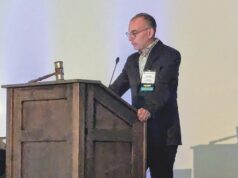
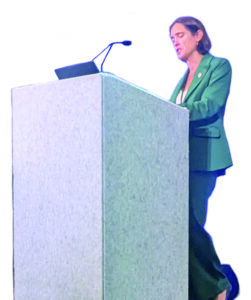
That was the message from Jessica Simons, MD, the 2024–25 president of the New England Society for Vascular Surgery (NESVS), a professor of surgery at UMass Chan Medical School in Worcester, Massachusetts, and the institution’s integrated vascular surgery residency program director.
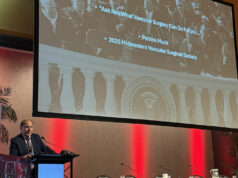
Simons was giving her outgoing presidential address at the 2025 NESVS annual meeting in Providence, Rhode Island (Sept. 26-28) on the topic of generational change in vascular surgery, exploring the values of each generation and those that endure in the context of the future of the vascular workforce.
Amid workforce pressures and some researchers predicting a surplus of vascular surgeons deeper into the future, Simons questioned how care delivery will look. “Given that surgeons are pulled in so many directions, yet seek a reduced clinical workload, we likely need that surplus of surgeons that some researchers are projecting and maybe more so,” she said. “How can we maintain continuity with and accountability to our patients without working 24/7, 365 or even 80 hours a week?”
Fundamentally, she asked, can adaptations to work be made so that surgeons can meet their personal goals without compromising patient care? Simons explored shifting attitudes toward work across generations—Baby Boomers and Gen X, Y and Z—which roughly goes like this, she said: “Boomers live to work, Gen X works to live, Gen Y wants to live, live, live and work as they need to.”
“One of these isn’t better than the other,” Simons added. “Everyone in vascular surgery works pretty darn hard. But attitudes toward work have changed. And the example of blurred work-life boundaries is particularly interesting.”
While acknowledging her attitude reflects the generation from which she comes, Gen X, Simons underscored that “our work-life balance equation has to reflect that it is not just about me and my home life.”
How is this achieved? she pondered.
“How do we meet the demands for patient care while meeting the demands for life outside of work, all while stretched thinner than ever across healthcare and experiencing a shortage of surgeons? It sounds pretty impossible. But I would argue this is a group that likes impossible challenges.”
But the basic tension underlying the question is the same as the one Gen X saw as their parents confronted a rapidly evolving culture and home and work-life dynamics, Simons added—“a conundrum that is shared across generations.”
In common with the answer to “Why vascular?”, “we have more in common than we realize,” she told NESVS 2025. Some values, such as the altruism that might be contained in a desire to engage in longitudinal care, are conserved across generations, she said.