Brought to you by:

Future research needed to ‘optimize’ use of imaging technologies during aortic procedures
Imaging technologies in the aortic space will be a key feature of Saturday’s Plenary Session 8 (11:15 a.m. to 12:30 p.m.) in Potomac A/B, with speakers set to share data on Philips’ Fiber Optic RealShape (FORS) technology and Centerline Biomedical’s…
Study weighs up total transfemoral and upper extremity approaches for F/BEVAR

In a prospective, non-randomized study, researchers found that a total transfemoral approach was associated with lower rates of cerebrovascular events and improved outcomes compared to an upper extremity approach during fenestrated/branched endovascular aneurysm repair (F/BEVAR). Thomas Mesnard, MD, research fellow…
Award-winning paper finds F/BEVAR ‘feasible and safe’ in patients with failed aortic repairs
Presenting award-winning new research, Andrea Vacirca, MD, a research fellow at The University of Texas Health Science Center in Houston (UTHealth Houston), revealed how, despite prior records which demonstrate that fenestrated-branched endovascular aortic repair (F/BEVAR) is “feasible and safe” in…
F/BEVAR has high technical success and low mortality in chronic post-dissection TAAA
Fenestrated/branched endovascular aneurysm repair (F/BEVAR) is associated with high technical success and low mortality in patients with chronic post-dissection thoracoabdominal aortic aneurysm (PD-TAAA). This conclusion was presented by Mohamed A. Abdelhalim, MBChB, a PhD research fellow at St Thomas’ Hospital,…
Patients in Florida with complex aortic pathology gain unique access to F/BEVAR

This advertorial is sponsored by Tampa General Hospital. Patients with complex pararenal and thoracoabdominal aortic aneurysm (TAAA) disease are faced with limited treatment options outside of one of the most technically and physiologically demanding operations on a vascular surgeon’s schedule:…
Complex TAAA: US ARC IDE registry reports better survival vs. real-world data after endovascular repair
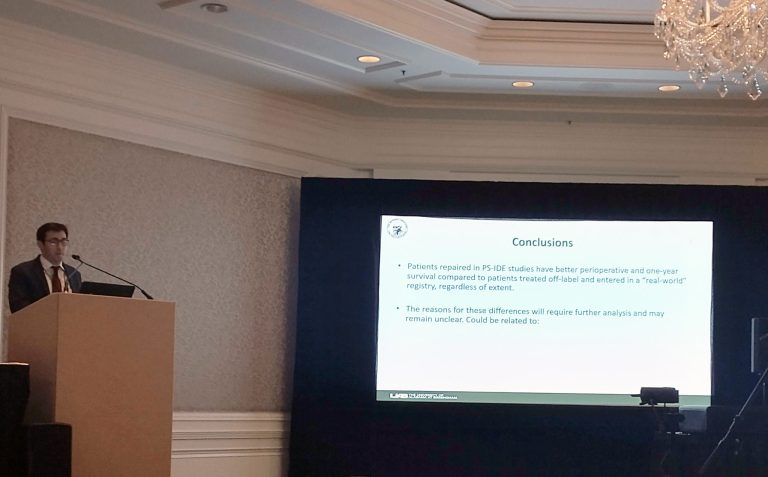
Patients treated in Food and Drug Administration (FDA)-approved investigational device exemption (IDE) trials for complex thoracoabdominal aortic aneurysms (TAAAs) in the U.S. Aortic Research Consortium (ARC) had better 30-day and one-year survival compared with those recorded in the real-world Vascular…
Significant reintervention after F-BEVAR ‘does not negatively impact survival’
Patients who underwent reinterventions after fenestrated and branched endovascular aneurysm repair (F-BEVAR) had improved long-term survival over those who did not undergo a secondary operation, a large study of all investigational device exemption (IDE) F-BEVAR procedures carried out at nine…
F-BEVAR performed on women shows ‘lower’ level of technical success
Fenestrated-branched endovascular aneurysm repair (F-BEVAR) for thoracoabdominal aortic aneurysms (TAAAs) carried out on women “demonstrate metrics of increased complexity and have a lower level of technical success, particularly among patients with higher extent aneurysms,” a research team in Seattle found.…
‘No evidence’ to suggest spinal cord injury is decreased by prophylactic drainage during EVAR procedures
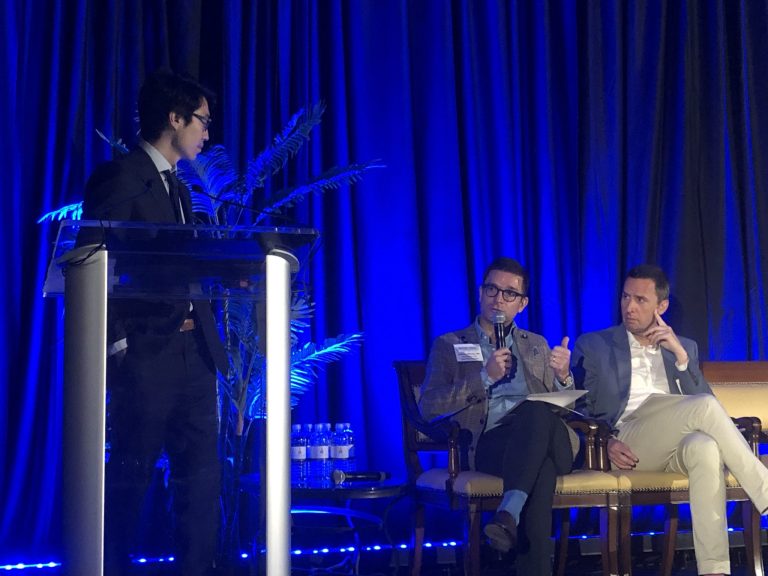
MIAMI—Cerebrospinal fluid (CSF) drainage is a key component in the treatment of spinal cord injury but the evidence that prophylactic drainage decreases such injury during endovascular repair (EVAR) is “at best weak,” Gustavo S. Oderich, MD, told the Critical Issues…