Brought to you by:

Endovascular CFA treatment associated with increased rate of long-term CFA-specific reintervention, study finds

A recent study suggests that endovascular treatment of the common femoral artery (CFA) is associated with an increased rate of long-term CFA-specific reintervention, regardless of indication. Nicholas Wells, a medical student at Yale School of Medicine in New Haven, USA,…
Sex-based analysis finds BEST-CLI data generalizable to female patients

A new secondary analysis of sex disparities in the best endovascular versus best surgical therapy in patients with critical limb ischemia (BEST-CLI) trial data has found that improved major adverse limb event (MALE)-free survival via open surgical bypass with single…
Endovascular CFA treatment associated with increased rate of long-term CFA-specific reintervention, study finds

A recent study suggests that endovascular treatment of the common femoral artery (CFA) is associated with an increased rate of long-term CFA-specific reintervention, regardless of indication. Nicholas Wells, MA, a medical student at Yale School of Medicine in New Haven,…
VAM 2024: Enhancing clinical practice and patient interaction in CLTI

A key event on informed decision-making in chronic limb-threatening ischemia (CLTI) promises to be a highlight of the 2024 Vascular Annual Meeting (June 19–22). Funded by a grant from the Council of Medical Specialty Societies (CMSS) awarded to the SVS, the…
The role of deep venous arterialization comes under scrutiny

“Every so often in vascular disease, disruptive technologies come along and the question really is, ‘Is this going to make a big impact on patient care?’” These were the words of CX Executive Board member Robert Hinchliffe, MBChB, clinical professor…
PAD guideline update from ACC, AHA and others centers multispecialty care

New multisociety clinical practice guidelines for the management of lower extremity peripheral arterial disease (PAD) have been published online in the Journal of the American College of Cardiology (JACC). One of the document’s key takeaway messages is that care for…
‘Who let a vascular surgeon in the room?’: Leadership in the face of turf battles in vascular disease treatment

Leading vascular surgeons from across the globe contributed pearls of wisdom on how to go about tackling inevitable turf battles from other specialties practicing in the vascular disease space during a leadership challenges session staged by the World Federation of…
Abbott’s Esprit BTK scaffold system given US FDA approval for CLTI treatment

Abbott has announced that the US Food and Drug Administration (FDA) has approved the Esprit BTK everolimus-eluting resorbable scaffold system (Esprit BTK system), a breakthrough innovation for people with chronic limb-threatening ischemia (CLTI) below-the-knee (BTK). The Esprit BTK System is…
Endovascular showdown: CX 2024 sets the stage for BASIL-3 first-time data presentations
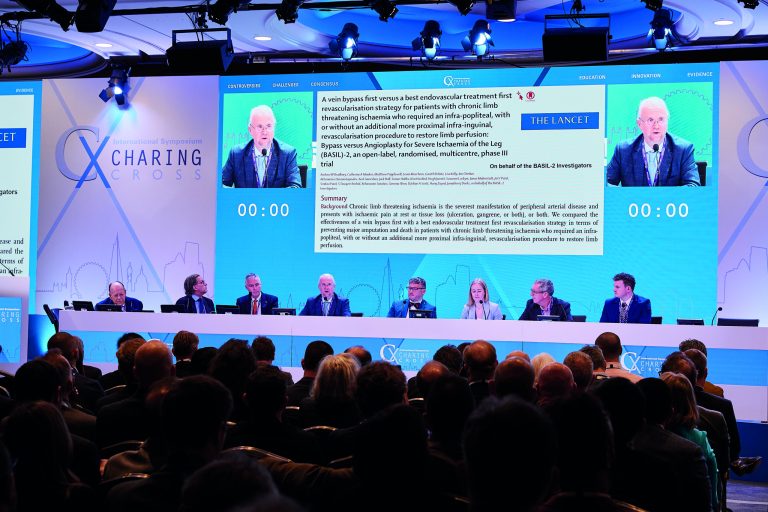
At the Charing Cross (CX) Symposium 2024 (23–25 April, London, UK), Andrew Bradbury (University of Birmingham, Birmingham, UK) and the BASIL-3 team of triallists will address the pressing question of which endovascular strategy wins in the disputed femoropopliteal segment. The…
FDA Breakthrough Device designation granted for DynamX BTK for use in CLTI treatment below the knee
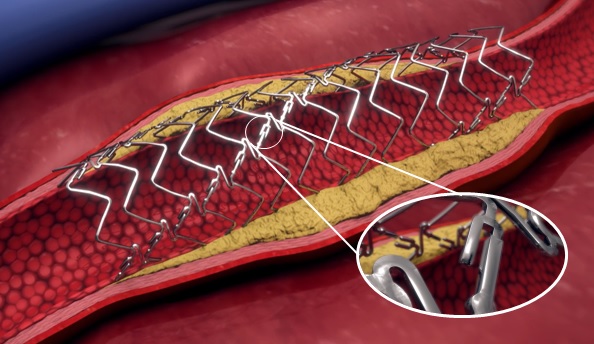
Elixir Medical has announced Breakthrough Device designation by the Food and Drug Administration (FDA) for its novel DynamX BTK System, an implant for use in the treatment of narrowed or blocked vessels below-the-knee (BTK) in patients with chronic limb-threatening ischemia…