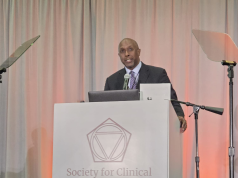

Current communication practices often fail to help patients and their families understand if surgery is right for them, argued Margaret “Gretchen” Schwarze, MD, during a distinguished visiting professor address at the 2026 Society for Clinical Vascular Surgery (SCVS) Annual Symposium in San Diego, California (March 28-April 1).
While clinicians are doing the best they can with the framework they were given, she said it does not adequately prepare patients for what surgery may actually involve. Schwarze, professor of surgery at the University of Wisconsin School of Medicine and Public health, illustrated the problem through the case of a frail woman in her late 70s who underwent surgery for a thoracoabdominal aneurysm after was told she faced a 50% chance of death, a 60% chance of dialysis and an 80% chance of being stuck on a ventilator.
After the surgery, Schwarze said the patient was doing fairly well in the ICU. However, when the family came in and saw how she looked — puffy all over, lines of drip behind her, tubes everywhere — they said it was not what she would have wanted and made the difficult decision to withdraw life-supporting treatment.
“If I had to describe to you what happened to this patient, I would tell you that she received unwanted care,” said Schwarze. “If I had to explain to you why it occurred, I would say that the way all of us have been taught to talk to patients about the consequences of surgery, using probabilistic language, is not helping our patients and families understand whether surgery is right for them.”
Schwarze said families often hear those numbers and conclude that the patient still has a meaningful chance of returning to baseline, even when surgeons know that’s very unlikely. “I know there’s not a person in this room who would believe that was true,” said Schwarze. “My concern is we are doing as well as we can with what we’ve been taught, but it doesn’t help our patients and families figure out whether surgery is right for them.”
To address that gap, Schwarze described a communication framework developed in her lab called “best-case, worst-case.” The approach combines a simple graphic aid with scenario planning, asking surgeons to describe best-case, worst-case and most likely outcomes for each treatment option.
“It’s this idea of how to manage uncertainty,” said Schwarze. “We don’t know how this will go, but we actually have a pretty good idea of what it looks like when things do go well. We want to use a story to describe that narrative.”
She said surgeons also need to be more explicit about what surgery is actually intending to accomplish. In her research recording surgeon-patient conversations, she found clinicians often spend most of their time discussing anatomy and operative technique, while failing to name the actual goal of surgery. “Surgery can only do four things,” she said. “It can help you live longer, it can help you feel better, it can prevent a disability or it can make a diagnosis. That’s it.”
Instead, Schwarze said interventions are frequently described as a way to “fix” a problem, which allows patients to attach their own hopes to it. “It is a very easy sell,” she said. “The problem with it being a very easy sell is it’s really hard to walk it back when you don’t think surgery will help them. Fix-it language creates this idea that people will be normal again after we simply fix the problem. It’s very hard to get out of that language.”
Ultimately, Schwarze said recognizing emotion during conversations is something surgeons need to do better. “What we could all do as surgeons is think about what to say when a patient says to you, ‘Isn’t there anything else you can do,’” she said. “The answer is not, ‘Well, sure, I can do a fourth time redo bypass below-the-knee with PTFE.’ The reason that’s not the answer is because that’s not going to meet anybody’s goal. What should you say instead? ‘I wish. I’m on your side.’”