Brought to you by:

TCAR and endarterectomy both ‘reasonable’ but stenting linked to worse outcomes in kidney disease patients
A study examining outcomes between different carotid revascularization procedures has concluded that transcarotid artery revascularization (TCAR) and carotid endarterectomy (CEA) both represent a “reasonable choice” in severe chronic kidney disease (CKD) and hemodialysis patients—but transfemoral carotid artery stenting (TF-CAS) appears…
Patient selection may explain ‘counterintuitive’ relationship between carotid stenting volume and outcomes in new study
High stroke and death rates relating to carotid stenting in the Pacific Northwest may be driven by the selection of high-risk patients with less than 80% stenosis, and reducing the frequency of stenting in this high-risk group—along with better adherence…
One-year results confirm safety and efficacy results of conformable AAA device in highly angulated necks

Results of a sub-study from the pivotal Investigational Device Exemption (IDE) trial assessing Gore’s Excluder conformable abdominal aortic aneurysm (AAA) endoprosthesis have shown that the device is safe and effective in hostile angulated neck anatomy, with the results maintained out…
Community affairs: Optimizing, protecting and enhancing clinical practice

The SVS Community Practice Section (CPS) has put together an extensive 90-minute program for Thursday afternoon at VAM. The session, entitled Community Practice Section: Optimizing and Protecting your Clinical Practice, will take place on Thursday, June 20, from 1:30 to…
Vascular surgery trainees face the future armed similarly with both open and endovascular skills

The BEST-CLI trial underscores the importance of ensuring trainee competence in open peripheral revascularization as well as endovascular treatment. Indeed, the trial results have called for a reshift in focus to ensure trainees have much needed open skills. That’s because,…
Radiation safety session seeks to address variability and improve access to education

“Variability is a source of inferior quality, poor outcomes and harm,” says Anil Hingorani, MD, vascular surgeon at New York University (NYU) Langone in Brooklyn, speaking to VS@VAM ahead of Thursday morning’s VAM 2024 session on the past, present and…
APP united: Society for Vascular Nursing and SVS PA Section to host immersive program

The Society for Vascular Nursing (SVN) is again hosting its 42nd Annual Conference June 19–20 at McCormick Place alongside VAM 2024. This year’s meeting offers attendees a diverse offering, including an immersive program that will merge with the SVS Physician…
Analysis will kickstart conversation on F/BEVAR outcomes
New data presented during Friday’s Plenary Session 6 (10–11 a.m. in the West Building, Skyline Ballroom) will shed light on trends in the adoption of fenestrated and branched endovascular aortic repair (F/BEVAR) outside of Food and Drug Administration (FDA) Investigational…
Artificial intelligence: Breakfast session explores opportunities and risks for vascular surgery

The advent of artificial intelligence (AI) in vascular surgery holds great promise to optimize the delivery of care, with prospective uses including patient selection and procedural planning. Yet, challenges remain. Many still view AI with suspicion, and important ethical and…
Pediatric vascular trauma: ‘Collaboration really matters in this space’
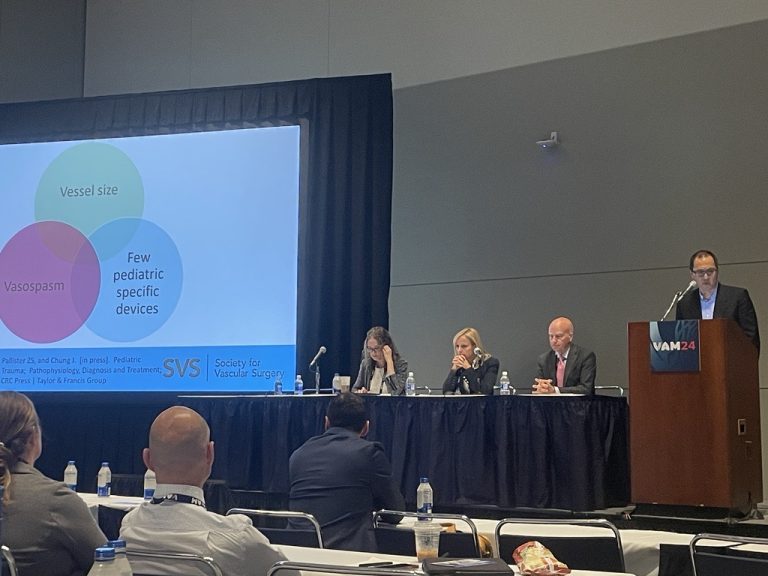
The focus of yesterday’s American Pediatric Surgical Association (APSA)-SVS task force’s spring quarterly interest group meeting at VAM 2024 was the “incredibly crucial” topic of pediatric trauma, as described by co-moderator John White, MD. Various speakers shared a series of…