Brought to you by:

Abre stent data show ‘struggle to maintain patency’ among post-thrombotic syndrome patients
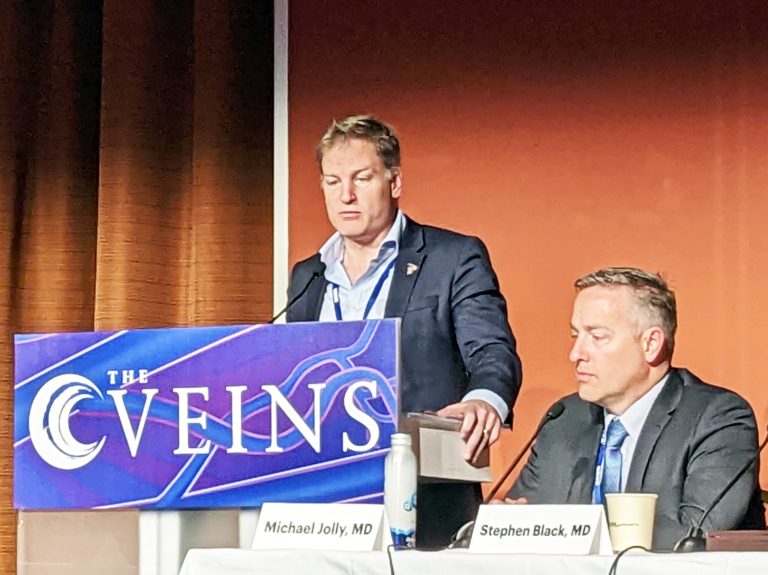
The Abre venous stent demonstrated three-year primary patency rates of 97.1%, 76.5% and 70.4% respectively for non-thrombotic iliac vein lesion (NIVL), acute deep vein thrombosis (DVT), and post-thrombotic syndrome (PTS) patient populations within the ABRE clinical study, a late-breaking session…
FLASH results demonstrate ‘excellent safety profile’ of the FlowTriever system in full US cohort

Results of the FLASH registry demonstrate the “excellent safety profile” of the FlowTriever system (Inari Medical) in 800 real-world patients. This is according to Catalin Toma, MD, from the University of Pittsburgh Medical Center, Pittsburgh, who presented outcomes for the…
Experts establish international standard set of outcome measures for patients with VTE

The International Consortium for Health Outcomes Measurement (ICHOM) venous thromboembolism (VTE) working group has developed a standard set of outcome measures for patients with VTE. The consensus recommendation—published in the September edition of The Lancet Haematology—is designed to “facilitate the…
Key differences in presentation, outcomes for distal versus proximal DVT uncovered

A new study highlights key differences in clinical features and comorbidities, as well as short-term and also long-term outcomes for patients with distal deep vein thrombosis (DVT) versus proximal DVT. The findings were recently published in JAMA Cardiology. The differences…
Compression duration affects pain during superficial venous intervention, study finds

Postprocedural compression of one to two weeks after superficial venous incompetence (SVI) treatment is associated with reduced pain compared with a shorter duration. This is according to a study published in the August edition of the British Journal of Surgery…
CLTI, VTE and post-thrombotic syndrome: Leading experts discuss crucial decision-making in interventional approaches

This advertorial is sponsored by ACHL. For Anahita Dua, MBChB, the stark realities and complexities of peripheral arterial disease (PAD) patients undergoing endovascular treatment for chronic limb-threatening ischemia (CLTI) coalesce into one important truth: the necessity of entering the operating…
Strength in numbers: Global VASCC COVID-19 project helps identify framework to tackle delayed cases

When Robert Cuff, MD, and Max Wohlauer, MD, first launched the Vascular Surgery COVID-19 Collaborative (VASCC) back in the spring of 2020, the pandemic was still in its first wave, and the goal of a new vascular surgery registry to…
The year in COVID: VAM to feature 10 talks probing pandemic-related vascular complications

After nearly 18 months of life dominated by a worldwide pandemic—one that canceled the 2020 Vascular Annual Meeting (VAM)—VAM 2021 highlights several aspects of COVID-19 in a special session. The coronavirus session will be from 5 to 6:30 p.m. Wednesday…
Surmodics builds thrombectomy portfolio with acquisition of Vetex Medical

Surmodics recently announced that it has acquired privately-held Vetex Medical Limited, expanding the company’s thrombectomy portfolio with a second Food and Drug Administration (FDA) 510(k)-cleared device, the ReVene thrombectomy catheter. The ReVene mechanical thrombectomy catheter is specifically designed to remove large,…
Adjunctive compression to standard prophylaxis for postoperative VTE shows benefit in very high-risk patients

Among patients with a Caprini score of ≥11 who received standard prophylaxis for venous thromboembolism (VTE), adjunctive intermittent pneumatic compression (IPC) resulted in a significantly lower incidence of asymptomatic venous thrombosis. This is according to the findings of the IPC SUPER…