Brought to you by:
Coaches ‘integral’ to SVS SET app program

“A good coach will make his players see what they can be rather than what they are.” Those are words ascribed to football coach Ara Parseghian, who guided the University of Notre Dame to two national championships in the 1960s…
Supervised Exercise Therapy: There’s an app for that
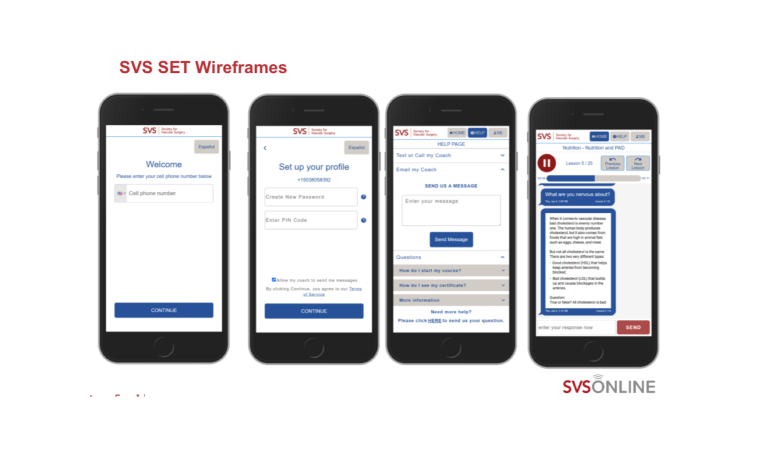
Call it timing on several fronts, each part coming together for the benefit of patients with peripheral arterial disease (PAD). Included in the mix was an interest on the part of the Society for Vascular Surgery (SVS) to utilize technology…
Postmarket study of sirolimus-eluting balloon enrolls first patient

MedAlliance has announced enrollment of the first patient in SUCCESS PTA, its large post-market study with the drug-eluting balloon Selution SLR for the treatment of patients with peripheral arterial disease (PAD). Selution SLR is a novel sirolimus-eluting balloon that provides…
Veterans study: No evidence of increased risk of death with use of PCDs out to three years

A study of more than 10,000 U.S. veterans with peripheral arterial disease (PAD) undergoing endovascular interventions in the femoropopliteal segment found that rates of two‐ and three‐year all‐cause mortality were similar among patients undergoing revascularization with a paclitaxel-coated device (PCD)…
How to succeed in vascular surgery: A guide for the aspiring outlier

Disclaimer: The views expressed here do not reflect those of Mayo Clinic, the Society for Vascular Surgery, Vascular Specialist, or even the author, for that matter. It’s satirical—everybody relax. Our recent paper, “Practice patterns of vascular surgery’s ‘1%’” created a…
Walking can relieve leg pain in people with PAD

Exercise can play an important role in treating peripheral arterial disease (PAD), a recent review by Amy Harwood, PhD, from the Centre for Sport and Exercise Life Sciences at Coventry University and the faculty of health sciences at the University of…
Target 2021: SVS councils and committees drill down on key goals for year ahead (Part 2)

While there is little doubt the pandemic has impacted each vascular surgeon and the SVS as a Society in numerous ways, the commitment and dedication of SVS committee, council and task force members to deliver on the mission has remained…
‘Successful’ first-in-human use of the Efemoral scaffold system announced

Efemoral Medical has announced the first-in-human (FIH) use of the company’s Efemoral Vascular scaffold system (EVSS) with FlexStepv technology in the EFEMORAL I FIH clinical study. The medical device company said the technology offers a new approach to treat peripheral…
WIfI score found to be accurate across racial groups

The wound, ischemia and foot infection (WIfI) score is as accurate a predictor of risk for limb loss in Black people as it is among whites, an SVS Foundation-supported study found. The research on patients with chronic limb-threatening ischemia (CLTI)…
Revascularization ‘improves’ walking performance in claudicating PAD patients

Revascularization of the lower extremity improves hemodynamics, walking performance, quality of life and calf-muscle pathology in claudicating patients with peripheral arterial disease (PAD), researchers in Nebraska found. Furthermore, baseline systolic pressure in the foot, at 15 seconds after relief of…