Brought to you by:

End-stage CLTI: Deep-vein arterialization procedure demonstrates amputation-free survival rate of 66% at six months
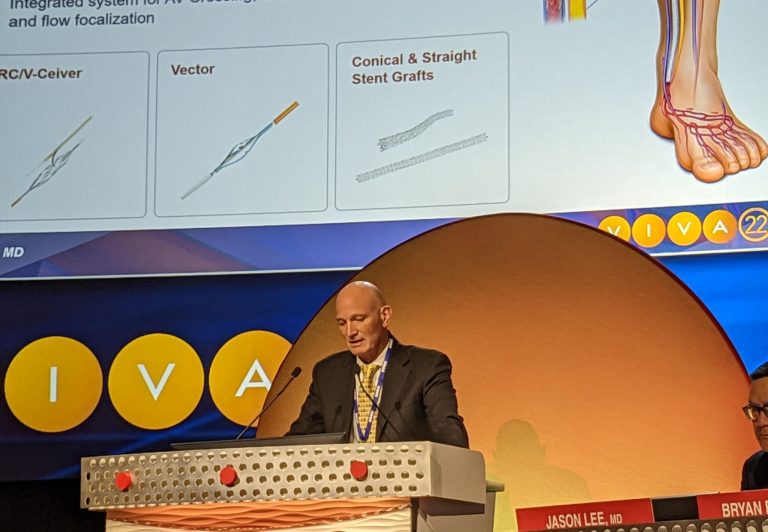
Six-month results from the PROMISE II trial of the LimFlow deep-vein arterialization system showed an overall amputation-free survival of 66%—“well above” the primary endpoint target of 54%, chief investigator Daniel Clair, MD, told the 2022 Vascular Interventional Advances (VIVA) meeting…
BEST-CLI attracts $3.3m funding injection to continue data analysis

The Novo Nordisk Foundation has made a $3.3 million contribution toward the BEST-CLI (Best endovascular vs. best surgical therapy in patients with critical limb ischemia) clinical trial, the Denmark-based entity has announced. The grant is set to be used by investigators…
CLI at a crossroads: Which direction now?

Vascular surgery once again finds itself at a crossroads, Michael Belkin, MD, chief of the division of vascular and endovascular surgery at Brigham and Women’s Hospital in Boston, told the Western Vascular Society (WVS) annual meeting (Oct. 16–19) in Jackson…
VIVA 2021: IVL ‘consistently’ treats real-world calcium in multiple peripheral vessel beds

An interim analysis from the DISRUPT PAD III observational study showed that intravascular lithotripsy (IVL) performs “consistently well” across challenging peripheral vessels, lesions and subgroups of patients, Ehrin J. Armstrong, MD, medical director at Adventist Heart and Vascular Institute in…
PAD: R3 Vascular reports ‘successful initiation’ of first-in-human study of bioresorbable sirolimus-eluting scaffold

Medical device developer R3 Vascular has reported the “successful initiation” of a first-in-human clinical study evaluating the technical and clinical performance of its Magnitude bioresorbable sirolimus-eluting scaffold (BRS) in patients with critical limb ischemia (CLI) due to occlusive below-the-knee (BTK)…
Latest meta-analysis on paclitaxel in peripheral arterial disease provokes mixed reception

“There appears to be heightened risk of major amputation after use of paclitaxel-coated balloons [PCBs] in the peripheral arteries,” findings from a systematic review and meta-analysis of randomized controlled trials (RCTs) published in the European Journal of Vascular and Endovascular…
Fighting the good fight: The case for multidisciplinary limb salvage in face of increasing diabetes, diversifying nation

Dramatic increases in rates of diabetes—particularly among Black females—through 2060 underscore the importance of a multidisciplinary team approach to limb salvage, according to Vincent Rowe, MD, professor of vascular surgery and endovascular therapy in the Keck School of Medicine at…
Stenting found to be superior to atherectomy, balloon angioplasty in reducing PAD mortality risk

Stenting reduced mortality risk in patients undergoing interventions for peripheral arterial disease (PAD) by more than 30% when compared to plain balloon angioplasty, and 40% contrasted with atherectomy, a recent propensity-matched analysis found. The Vascular Quality Initiative (VQI)-derived data drew…
Intermittent claudication and exercise therapy: A poor SET-up

Many of you may have already heard about the controversial Comparative Billing Reports (CBRs) that have been received by some of our vascular surgery colleagues. In case you haven’t, this is your chance to catch up and to prepare for…
TCT 2020 late-breaking trials session features new data on drug-coated devices
Findings from a series of late-breaking trials in the endovascular field were delivered recently at TCT Connect (Oct. 14–18), the 32nd annual scientific symposium of the Cardiovascular Research Foundation (CRF), held virtually, with the first from Connie N. Hess, MD,…