Brought to you by:


From reactive to proactive: CHAMPIONS builds nationwide effort around PAD prevention
“We’ve always approached peripheral artery disease in a very reactive way in that we wait for a patient to show up in our office or the emergency room with claudication, rest pain or gangrene and only then do we intervene, treating symptoms, restoring blood flow and trying to prevent limb loss after the disease has already declared itself,” said Leigh Ann O’Banion, MD, associate clinical professor in the department of surgery at the University of California, San Francisco Fresno.
According to O’Banion, that’s a markedly different way of thinking about a systemic issue than other specialties think about theirs. She used colon and breast cancer as examples, due to both having early detection and prevention programs that are widely accepted as standards of care. Although different organizations have advocated for PAD screening, she said having providers actually do it is a different story.
“I love referencing this study because it’s so alarming,” said O’banion. “Dr. Misty Humphries and her colleagues at UC Davis reached out to local primary care providers and educated them on ankle-brachial index (ABI) testing and wound, ischemia, foot infection (WIfI) classification. The providers took a pre- and post-test and were seen to be educatable. The providers were then asked if they were going to start screening patients in their office. They said no, not for lack of knowledge, but lack of resources and reimbursement.”
That disconnect between knowledge and implementation was what led O’Banion to create the Comprehensive Heart and Multidisciplinary Limb Preservation Outreach Network, also known as CHAMPIONS. The initiative aims to identify PAD risk and disease earlier and connect individuals with education and evidence-based risk-factor modification to prevent disease progression.
“CHAMPIONS, at its core, is meant to shift the mindset into a proactive way of thinking about PAD and intercept the patient before advanced disease is present,” said O’Banion, “so that we decrease the number of patients we're seeing with advanced tissue loss where revascularization is no longer an option.”
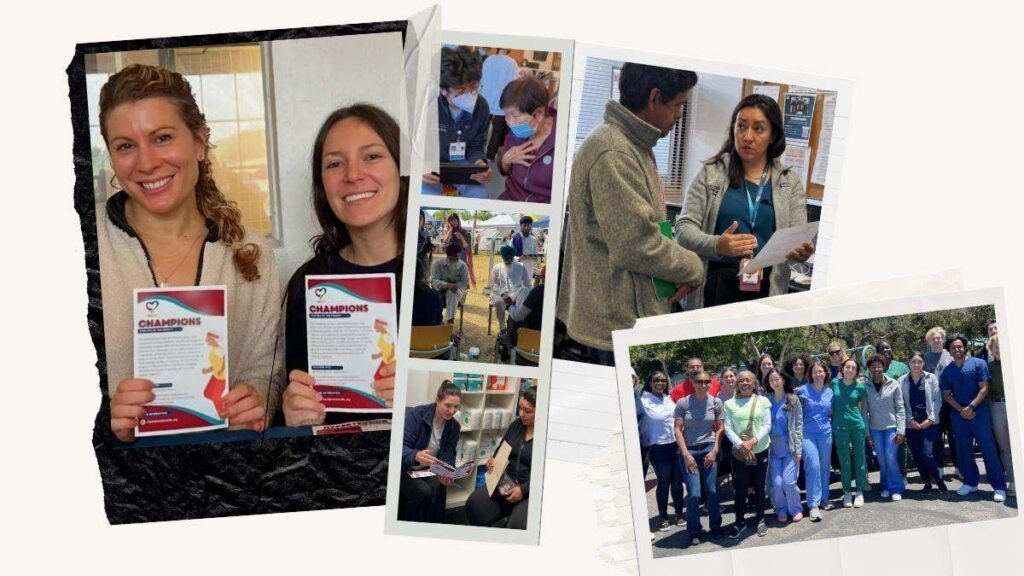
CHAMPIONS offers onsite screening, consultation and education at social events in the community, such as fairs, festivals and food drives. During the events, medical providers, students and volunteers screen participants for cardiovascular and vascular risk factors, provide individualized education and results, connect underserved patients with primary care and refer patients to specialists.
O’Banion said the data gathered from CHAMPIONS so far has shown that the incidence of diagnosing PAD at the events is around 8%, which is similar with the PAD incidence across the United States and about 50% of those screened are qualified as at risk. Recent data from the screenings also demonstrated that despite similar guideline-based PAD risk classification, females had more than fourfold higher odds of PAD detection compared with males.
Samantha Minc, MD, associate professor of surgery at Duke University School of Medicine, said that the events have also been great for developing relationships with key community partners. “We only have one federally qualified health center in Durham and these folks are often resource strapped,” she said. “We show up and do a screening next to them and offer to do the blood pressure so that the one doctor that showed up can talk to the patients. It starts to build roads and gives us a face in the community. I think that's really important to make people comfortable to come to us when they need us.”
Another key aspect of CHAMPIONS is providing the next generation of vascular surgeons with hands-on training in underserved communities, said O’Banion. “If we don't educate them about it while they're in training, then they go out into the community and they just want to practice in a big metropolitan city,” she said. “Or they want to be in some other specialty because they've never heard about vascular surgery.”
Humphries, an associate professor of surgery at University of California, Davis, said this was critical because most medical students don’t know what vascular surgery is. “There's a survey that polls what students want to do when they go into medical school and when they graduate,” she said. “Only 1% of residents who go into vascular surgery knew they wanted to go into it when they applied to medical school. Most didn't know anything about it. They had no clue what it was when they applied to medical school.”
Matthew Corriere, MD, professor of surgery at the Ohio State University Wexner Medical Center, became involved with CHAMPIONS because it aligns with his research of making PAD treatment more patient-centered. He said his students are always eager to participate in the screenings so they can have a positive impact on patient care in the community.
“Everybody wants in on this and it's easy to make a project happen when it's like that,” said Corriere. “We have several residents and fellows at Ohio State participating because they heard about it and want to be involved. There's a different kind of energy when community partnering is involved. It gives people a sense of purpose and a mission and impact. That's great because, as vascular surgeons, we often see people with very late stage disease. This puts not only our practice, but our mindset as well, further upstream. The opportunities for prevention and education is a refreshing thing to be able to pull off.”
Due to the success of CHAMPIONS, O’Banion partnered with Isabel Bjork, the CEO of the Foundation to Advance Vascular Cures, who she met through doing research on vascular deserts. CHAMPIONS has now been fully incorporated into the foundation, which is giving it the chance to expand into a nationwide effort.
“What's interesting about CHAMPIONS is it's really gotten people excited about PAD prevention,” said Bjork. “I think part of that is the community-based aspect. Part of it is the sense that we're getting there early on in the conversation and raising awareness. There's a sense among the medical students, volunteers and supervising clinicians that we're able to expand the knowledge base in ways that are going to make a real difference. I'm extremely excited about CHAMPIONS. It's very big. It's very ambitious. It's hard to run but it's a passion project. I'm so relieved that we've found an area of excitement that's galvanizing people.”
CHAMPIONS now has nine sites across the country and to ensure that actionable research comes from the work, the foundation and participating sites gained Institutional Review Board approval. O’Banion said they are currently working on implementing more in diverse areas. She hopes adding more partners to the program allows data collection to ramp up so that they can continue to do important work and understand the patient population better. However, she said institutional funding that recognizes programs like CHAMPIONS will be critical moving forward.
“I am looking forward to one day having a map that's going to tell us exactly where we need to go to focus our efforts,” said O’Banion. “I think CHAMPIONS is going to give us the granular data to really understand who these people are and how we get to them. I envision a day where you can screen a person at a CHAMPIONS event and that data gets put into an electronic health record. The long-term vision is showing government institutions across the United States what a valuable thing a program like CHAMPIONS is so that this care can be afforded to all.”